
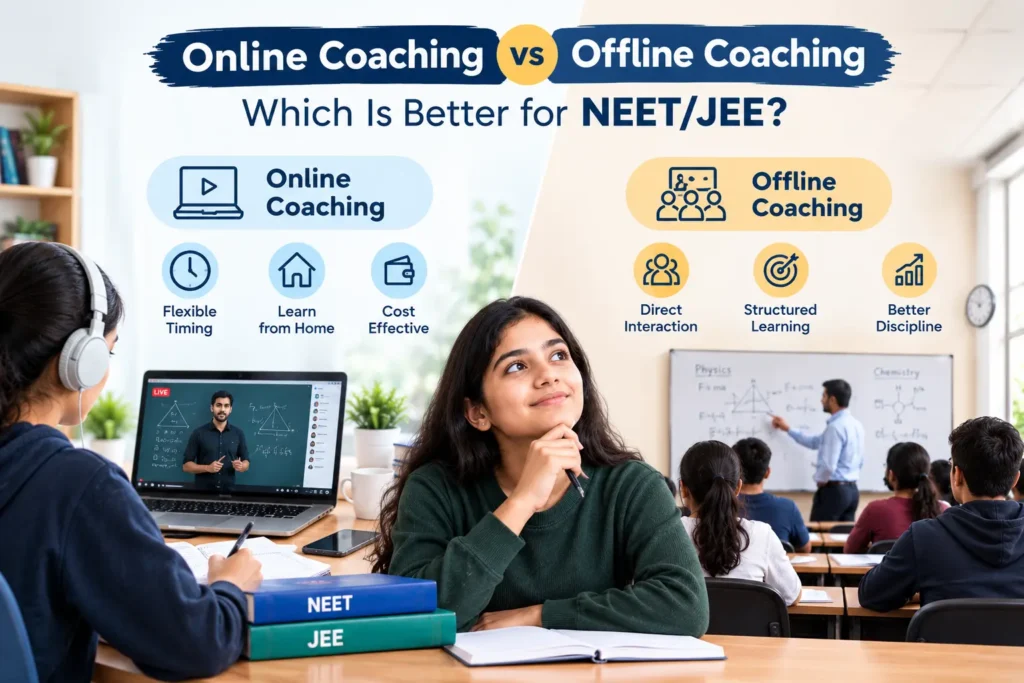
Neither online nor offline coaching is universally better for NEET or JEE. Offline coaching gives faster, face to face doubt resolution and enforced daily discipline. Online coaching costs less and offers more flexibility. The right choice depends on how consistently a student studies without supervision, how quickly they need doubts resolved, and what a family can realistically afford, not on which format has the better reputation
Quick Comparison: Online vs Offline Coaching?
| What matters | Online coaching | Offline coaching (residential) |
| Typical cost | Roughly 20,000 to 1,30,000 rupees for a full program | Roughly 1,00,000 to 4,00,000 rupees, plus hostel and travel |
| Flexibility | High, study from anywhere, revisit recorded lectures anytime | Low, fixed classroom schedule and location |
| Discipline | Depends entirely on the student, nothing enforces attendance | Built into the schedule, attendance and pace are supervised |
| Doubt solving | Often delayed to scheduled sessions or chat support | Same day, face to face with a teacher |
| Peer competition | Limited, unless the platform builds in live cohorts | Constant, with peers preparing for the same exam |
| Test series | Frequent and easy to schedule at any time | Structured, timed to match the actual exam calendar |
| Faculty access | Usually chat, forums, or scheduled calls | Direct, in person, typically daily |
| Travel or relocation | None required | Often required, especially for residential programs |
| Best for | Self directed students, tight budgets, health or family constraints | Students who need external structure to actually put in the hours |
What Is Online Coaching for NEET/JEE?
How It Works
Online coaching for NEET and JEE typically combines live streamed classes, a library of recorded lectures a student can revisit anytime, chapter wise practice sets, and an app or chat channel for doubts. Some platforms add live cohort sessions to recreate a classroom feel, while others are fully self paced.
Pros
Lower cost than a residential program, flexibility to study around school hours, ability to rewatch a confusing lecture as many times as needed, and no requirement to relocate away from home.
Cons
Requires real self discipline since nothing forces attendance, doubt resolution is often delayed to a scheduled slot or a queue, and there is little to no peer environment unless the platform builds one in deliberately.
What Is Offline Coaching for NEET/JEE?
How It Works
Offline coaching runs through physical batches, either at a local coaching center or through a residential setup that combines classes with a hostel in one campus. Students follow a fixed timetable, sit with the same peer group through the program, and can ask a teacher a question in the same room it came up in.
Pros
Same day doubt resolution, a schedule that is enforced rather than optional, constant peer competition that many students find motivating, and direct access to faculty on a daily basis.
Cons
Meaningfully higher cost once hostel, food, and travel are included, little flexibility if the pace does not suit a specific student, and for residential programs, real distance from home that takes some adjustment.
Online vs Offline Coaching: Detailed Comparison
Cost and Total Expense
Online programs run from roughly Rs 20,000 to Rs 1,30,000 for a full course. Offline, classroom based coaching typically runs from Rs 1,00,000 to Rs 4,00,000 or more for a one to two year program, and residential setups add hostel, food, and travel on top of that. The gap is real, but it is worth calculating total cost rather than sticker price. Students in offline coaching needed supplementary coaching at 9.4 percent, versus 36 percent for students who started with a purely online plan, a pattern that can narrow the effective cost gap over time.
Quality of Teaching and Faculty
Among students who had already secured a medical college seat, average satisfaction with their coaching sat around 70 percent, but the breakdown by format matters more than the average. Online coaching scored better on study materials and test frequency. Offline coaching scored better on faculty interaction specifically.
Doubt Clearing Support
This is the single clearest gap between formats. Only about half of online students reported being satisfied with doubt resolution, while offline students consistently rated this stronger, largely because a teacher is physically present rather than a message away.
Discipline and Consistency
Offline coaching builds consistency in by design, since attendance and pace are supervised. Online coaching leaves this entirely to the student, which works well for someone who already studies independently and works poorly for someone who does not yet have that habit.
Test Series and Performance Tracking
Online platforms tend to offer more frequent, flexible test series that a student can take on their own schedule. Offline programs usually run a more structured test calendar, timed deliberately to mirror the actual exam, which can be a more realistic simulation of exam day conditions.
Mental Health and Burnout
NEET and JEE preparation is genuinely demanding, and both formats carry a real risk of burnout if a student is pushed too hard for too long without breaks. Online coaching puts the responsibility for pacing almost entirely on the student and family, which can mean burnout goes unnoticed longer since no one outside the home sees the daily routine. Offline and residential coaching puts a student in a high pressure peer environment for extended hours, which suits some students and overwhelms others. Whichever format a family chooses, it helps to build in real rest, watch for signs of prolonged exhaustion or loss of motivation rather than just falling grades, and make sure a student has someone, a parent, a mentor, or a counselor, they can talk to honestly if the pressure becomes too much. A residential program is worth judging on whether that support is actually built in, not just promised, things like a dedicated counselling centre and regular updates to parents, rather than left to chance.
Results and Success Rates
NEET and JEE are both extremely competitive at a national level, and current official numbers make that concrete. For NEET UG 2026, close to 20 lakh candidates appeared and 11.21 lakh qualified, a qualification rate of roughly 56 percent, with results declared on 16 July 2026. For JEE, the funnel narrows further at each stage, 179,694 candidates appeared for JEE Advanced 2026 and 56,880 qualified, about 31.6 percent, competing for a total IIT seat count generally cited in the range of 17,000 to 20,000 seats nationally. No published, coaching format specific data breaks these results down by online versus offline preparation, so treat any institute’s claim of a guaranteed result, in either format, with real skepticism. Ask for verifiable numbers, not a promotional figure, and where they exist, check them directly, Shaheen publishes its own NEET and JEE result documents year by year rather than a single headline claim.
NEET vs JEE: Does the Best Mode Differ?
The format that works better can shift slightly depending on the exam. NEET leans heavily on NCERT recall and repeated revision across three subjects, which is exactly where recorded online lectures have a genuine advantage, since a student can rewatch a specific biology chapter as many times as needed until it sticks. JEE rewards concept application and problem solving depth more than recall, which is where live mentoring and in person doubt resolution tend to matter more, since a single unresolved concept in physics or mathematics can block several later problems. Neither difference is large enough to override a student’s own study habits, but it is a real, secondary factor worth weighing.
Which Type of Student Should Choose Online Coaching?
Online coaching suits a student who can follow a timetable without someone checking in every day. It works well if you live far from a coaching centre, want to avoid daily travel time, or are balancing school and preparation and need to study at flexible hours. It also suits students who like to rewatch lectures, practise at their own pace and learn from test reports. If you are comfortable with an app or laptop, Shaheen Digital Academy’s NEET and JEE online coaching offers live and recorded lectures, regular tests, performance analytics and 24/7 Ask AI doubt support, so you can prepare from home.
Which Type of Student Should Choose Offline Coaching?
Offline coaching suits a student who tends to procrastinate without a fixed class time, needs in person doubt resolution, or does better in a peer environment where everyone is preparing for the same exam. It is also a reasonable choice if you want a set daily routine, face to face guidance from teachers, or a residential setup with fewer distractions. For such students, Shaheen’s structured offline and residential NEET/JEE coaching is the relevant program.
Is Hybrid Coaching the Best Option?
For a meaningful number of families, the real answer is a specific combination rather than one format alone. Live online classes for the daily syllabus paired with periodic in person test series and mentoring, or offline classroom teaching paired with an online doubt app for evenings, both work well, as long as the two pieces are covering different jobs rather than duplicating the same syllabus twice, which tends to waste both time and money.
How to Choose: 7 Point Decision Checklist
- Budget: calculate the full cost, tuition plus any hostel, travel, or supplementary coaching likely to be needed, not just the headline fee.
- Learning style: does the student learn better from rewatching material at their own pace, or from a live classroom with immediate feedback.
- Self discipline: can the student maintain a daily study schedule without someone else enforcing it.
- Board exam balance: especially in Class 12, will this format protect time for school coursework or compete with it.
- Location: is relocation realistic for the family, and if not, does a strong option exist within reasonable daily travel distance.
- Target rank: does the specific exam and target score favor recall heavy revision or problem solving depth, and does the format support that.
- Faculty quality: ask directly about batch size, how quickly doubts get resolved, and how to verify any results claim rather than accepting it at face value.
Common Myths About Online and Offline Coaching
Online coaching is not automatically the cheaper choice once supplementary coaching is factored in, since offline students needed it at roughly a quarter of the rate online students did. Offline coaching does not automatically guarantee better results either, since online coaching scored higher on materials and test frequency, both of which matter for actual performance. And neither format has any published, verifiable data proving it produces better exam outcomes than the other at a national level, so any institute, online or offline, claiming a guaranteed result should be asked to show real, checkable numbers.
Frequently Asked Questions
What is the best coaching for NEET, online or offline?
Neither wins outright. Offline coaching tends to score higher on faculty access and doubt resolution, both important for NEET’s high volume, three subject syllabus, while online coaching tends to score higher on study materials and test frequency. The better fit depends on the specific student’s discipline and budget.
Is online coaching good enough for NEET on its own?
It can be, particularly for a self directed student with some other fast route to doubt resolution. For most students, some in person or live accountability meaningfully improves consistency.
Is online coaching effective for JEE?
Yes, especially for a disciplined student with strong problem practice habits, though offline still tends to hold an edge on fast doubt resolution in Physics and Mathematics specifically.
Is offline coaching always more expensive than online?
Typically, yes, and by a wide margin. Offline coaching usually costs Rs 1,00,000 to Rs 4,00,000 or more, against Rs 20,000 to Rs 1,30,000 for online, before hostel and travel are added.
Can a student switch from online to offline coaching if it is not working?
Yes, this is common. Offline students sought supplementary coaching at nearly four times the rate of online students, which suggests switching or supplementing happens often on both sides. A student who starts with online coaching can move to offline later, or the other way round.
Does hybrid coaching actually work for NEET and JEE?
It can, as long as the online and offline pieces are doing different jobs rather than covering the same syllabus twice. For example, a student in offline coaching can use online tests and analytics for extra practice.
How many students actually qualify NEET and JEE Advanced each year?
For NEET UG 2026, about 11.21 lakh of roughly 20 lakh candidates qualified, close to 56 percent. For JEE Advanced 2026, 56,880 of 179,694 candidates qualified, about 31.6 percent, competing for a limited number of IIT seats.
Conclusion
There is no single correct answer between online and offline coaching for NEET or JEE, and the data does not support picking one format as universally better. What the numbers do show clearly is that offline coaching wins on faculty access and doubt resolution, online coaching wins on flexibility and cost, and the right choice depends on a specific student’s discipline, budget, and how quickly they need a stuck doubt answered.
Shaheen offers both routes, so you can choose the one that suits your child.
For offline and residential coaching: Shaheen runs offline, residential NEET and JEE programs built around daily structure and direct faculty access for students who do better with that kind of accountability in place. Explore the Shaheen offline NEET/JEE program or register directly.
For online coaching: Students who prefer to study from home, at flexible hours, can start with Shaheen Digital Academy. Explore NEET online coaching, JEE online coaching or talk to a counsellor to compare plans.